Madeleine Bunting writing in today’s Guardian about the flurry of atheist books on the market, says that “religious faith in the west came to be interpreted as a matter of the head and the intellect, and was bound up with the authority of an institution which expected submission: God was regarded as something to think about rather than do in large chunks of western religious practice which, preoccupied with institutional power, ended up in this current cul de sac.” Looking back it’s obvious that I spent my thirty five years of priestly ministry in the dying years of that mindset. The clues to what might become the future were there for us to see but those of us who stayed within the institutional church (in my case, of England) didn’t really get it in spite of our unease with what we were expected to believe. It was something to do with the steady drip, drip of the liturgy which still emphasises the gap between us and God, in spite of Paul Tillich’s ‘ground of being’ approach, which Bishop John Robinson so controversially spelt out in 1963.
So now, says Bunting, it’s OK to ‘do God’ and I agree that praxis is more important than belief. It’s just that I’m a bit unhappy with that phrase, ‘doing God’. These days I prefer a much more controversial phrase: ‘being God’. In his ‘The Little Book of Atheist Spirituality’ the French philosopher, Andre Comte-Sponville, writes, “Whether they are believers or not, mystics are those who no longer lack God. But is a God who is no longer lacking still God?”
I don’t know the answer to his question. My response is to ask another question: Why is it that when human beings, in our left brain dominated world, learn how to access the right brain (i.e. to meditate) they experience love, compassion and a sense of connectedness with all living things? And what did Jesus mean when, according to John’s Gospel he said, ‘I and the Father are one’ and ‘I am the vine. You are the branches.’?
Monday, 5 April 2010


Sunday, 4 April 2010
The Resurrection of the body.
So we come at last to the end of Holy Week and, according to the Gospel writers, the tomb is empty.
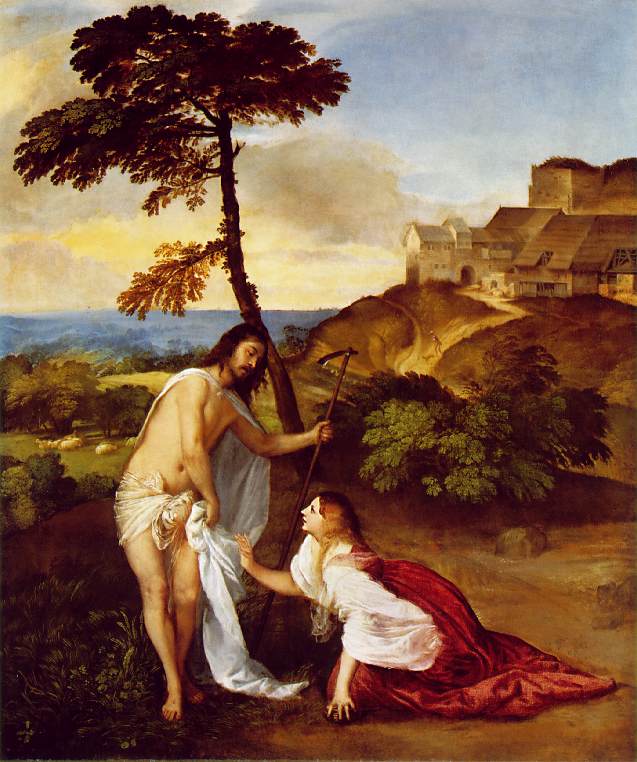
For me it’s been a week of wordy services (apart from a moving silent Eucharist on Wednesday). What’s more, most of the words used do not help me; indeed they hinder my sense of participating in new life by encouraging me to forget my connectedness with other human beings and the rest of the created world. John’s Gospel has Thomas, who doubted the Resurrection, demanding physical proof. He wanted to touch Jesus, in contrast to Mary who, in the same Gospel, encounters the risen Jesus in the garden and is told, ‘Don’t touch me’. (See Titian's wonderful painting of this moment.) It’s an understatement to say that the Gospels are ambiguous about the post-resurrection appearances of Christ. They have him eating food but passing through closed doors and going unrecognised even by those who loved him intimately. The controversial 1980s Bishop of Durham, David Jenkins, caused a storm by saying, ‘the Resurrection was not a conjuring trick with bones’, and ‘the bones of Jesus lie somewhere in Palestine’.
I wake up this morning feeling tired after a restless night and stuff starts flooding my head: ‘I shouldn’t be feeling like this’; ‘I’ll need a sleep this afternoon’; ‘my eyes are feeling prickly’. Then, mixed up with all this is theological stuff about what the church’s liturgy says that I don’t agree with. In other words I find myself forgetting that I am somebody: literally some-body. Eventually, I am reminded – yes, re-minded - and move from ‘doing’ mode to being mode by simply noticing, without judgement, the physical sensations that constitute the vibrant body that is me. Suddenly I feel alive again; connected with myself and the world in which I live and move and have my being and thus able to relate to my fellow human beings.
For me it’s been a week of wordy services (apart from a moving silent Eucharist on Wednesday). What’s more, most of the words used do not help me; indeed they hinder my sense of participating in new life by encouraging me to forget my connectedness with other human beings and the rest of the created world. John’s Gospel has Thomas, who doubted the Resurrection, demanding physical proof. He wanted to touch Jesus, in contrast to Mary who, in the same Gospel, encounters the risen Jesus in the garden and is told, ‘Don’t touch me’. (See Titian's wonderful painting of this moment.) It’s an understatement to say that the Gospels are ambiguous about the post-resurrection appearances of Christ. They have him eating food but passing through closed doors and going unrecognised even by those who loved him intimately. The controversial 1980s Bishop of Durham, David Jenkins, caused a storm by saying, ‘the Resurrection was not a conjuring trick with bones’, and ‘the bones of Jesus lie somewhere in Palestine’.
I wake up this morning feeling tired after a restless night and stuff starts flooding my head: ‘I shouldn’t be feeling like this’; ‘I’ll need a sleep this afternoon’; ‘my eyes are feeling prickly’. Then, mixed up with all this is theological stuff about what the church’s liturgy says that I don’t agree with. In other words I find myself forgetting that I am somebody: literally some-body. Eventually, I am reminded – yes, re-minded - and move from ‘doing’ mode to being mode by simply noticing, without judgement, the physical sensations that constitute the vibrant body that is me. Suddenly I feel alive again; connected with myself and the world in which I live and move and have my being and thus able to relate to my fellow human beings.
“Every breath we take includes a billion molecules of oxygen that have come from plants. And every molecule we breathe in has been at one time in the lungs of every one of the 50 billion humans who have ever lived. The simple act of breathing connects us in this intimate way with the plants and every person of the past of every race, religion and culture.”So at least one molecule of oxygen that I breathe in was in the lungs of Jesus of Nazareth. Now that is resurrection of the body!!
Monday, 29 March 2010
Now. And then.
It’s Holy Week: the crux (and that’s precisely the word!) of the church’s liturgical year. The Gospels devote a surprising amount of space to the last week of the life of Jesus of Nazareth; six out of Mark’s sixteen chapters, for example. Like much else in the Bible and subsequent Christian teaching, however, we struggle to understand what it might all mean. We think we know and quite often reject the understanding we have inherited.
The genius of the Christian church was to preserve a memory of Jesus of Nazareth and his teaching. The problem for us in the 21st century is that it did so in terms which are now alien to us. However, the church also managed to preserve aspects of Jesus which contradict the orthodox view of him and his message. So Christians rapidly made him into a saviour and it’s doubtful whether he would have approved of that. By the way, didn’t they equally rapidly make the Buddha into a saviour?
‘Kenosis’ is a New Testament Greek word meaning something like ‘self-emptying’; letting go of my ego. Most of what Jesus taught only makes sense if we remember that. Good Friday also only makes sense in that light. Jesus taught and lived a life of ‘kenosis’. He did not ‘die for my sins’. He died because, at that point, in those circumstances, any other course of action would have been unthinkably inconsistent with his teaching and his way of living. His death was not unique. Lots of people have surrendered their lives willingly for the same reason.
What Jesus did was to point to and demonstrate profound truths about what it is to be truly human. His was the power of living each moment as it comes, as it is, without burdens from the past or worries about the future. The thrust of his teaching is: the Kingdom is always present and available to us – now, and if you look anywhere (or perhaps I should say ‘anywhen’) else you’ll miss it. This is what he called ‘the narrow gate’ which few find.
The effect of the church’s annual round of festivals is to obscure this fundamental truth. For example, if I attend a Holy Week service recalling that last week of his life, I do it now. On Maundy Thursday I do it now. On Good Friday I may be recalling the then of that first Good Friday but I am doing so now. I am writing these words now and you (whoever or wherever you may be) are reading them now (whenever that may be). There is only always the eternal Now in which I can experience the power of (to use the Christian word) the resurrection. A church service too often says, ‘Look back to where you’ve come from; and look forward to where you’re heading. Jesus says, ‘Leave the dead to bury their dead’. Don’t be concerned about the future – ‘consider the lilies of the field’.
The Gospel, the good news, is: there isn’t anything else to know or do. The price (if that is the right word) is to let go of ego which is almost exclusively concerned with past and future. It’s not that we don’t have to remember and plan; only that to be fully human we must get the present right and then past and future begin to fall into place.
Friday, 26 March 2010
The Welcome Prayer & Depression
As promised in yesterday's post – some thoughts on the Welcome Prayer when dealing with persistent low energy situations like depression. I must come clean and say that I have nothing useful to add to what you can find in a marvellous book called, ‘The Mindful Way Through Depression’, by Mark Williams, John Teasdale, Zindel Segal and Jon Kabat-Zinn. If depression is what gets to you and if you don’t want to spend money on a Mindfulness Based Stress Reduction therapist then this book is a must. The authors are not fly-by-night self helpers. Mark Williams is Professor of Clinical Psychology at Oxford; John Teasdale is a research scientist at Oxford and Cambridge; Zindel Segal holds the Chair in Psychotherapy at Toronto University and Jon Kabat-Zinn is Emeritus Professor of Medicine at Massachusetts University Medical School. We’re talking serious scientists here.
And by the way, if depression is not an issue for you, don’t be put off by the title. I found the book very helpful in my developing practice of meditation, not least because it includes a companion CD of guided meditations. However, back to the Welcome Prayer; or rather on from the Welcome Prayer to page 183 of my edition of ‘The Mindful Way .....’ where you find something called ‘the three minute breathing space’. Guess what? It’s the Welcome Prayer in Buddhist mindfulness clothes!
Which brings me to a vista which some devotees of every religion find disturbing; at this level of conscious there is a remarkable sense of the unity of all created things. If you depend on the idea that your religious commitment is exclusive, that what you believe is the TRUTH which believers in other religions don’t possess then this is a vista you will want to get away from as soon as possible. Of course the standpoint from which we each catch a glimpse of this wonderful vista is culturally conditioned. Most of us here in what was western Christendom share a cultural heritage which is deeply imbued with Christianity. The good news is that going deeply into contemplative prayer brings us to the point at which we can see how much we share with our fellow human beings, no matter what their cultural background. In our global society that is Good News indeed.
Thursday, 25 March 2010
The Welcome Prayer
After last night’s final session of St. John's Waterloo Lent course I feel a bit like St. Paul with his concern for the embryonic Christian communities that he has planted around the place. How will they survive, how are they doing now? Is there anything further I can do to help and support them in their deepening way of living the Christian life? (If Paul had had the internet we would not now have his letters to those fledgling communities.) Pioneers in this way of being-in-the-world (of any religion or none) need all the support they can get and it's not always obvious where to find it. I have provided links to some web sites in earlier blog posts. As a recovering human being I need to 'touch base' with others on the same journey, through web sites, books, the occasional lecture, and often chance encounters with fellow travellers. For many years I've had the following quotation in my file and I have no idea where it comes from (if you know please tell me):
So our final session was called 'Pray without ceasing'; a title which highlights the difficulty of interpreting the experience of New Testament writers. The word 'pray' is a verb, suggesting something we do, whereas what we are discovering is a way of Being in the world; and I've used a capital letter there to indicate that this way of living always involves me in something greater than myself.
But the prevailing zeitgeist is doing, not being, so we have to unlearn stuff while developing under-used spiritual/psychological muscles and at first this feels 'clunky' like when we start learning to drive and have to think carefully about which foot pedal to press.
Earlier sessions in the course were about formal periods of meditation during which new muscles are being discovered, brain synapses are being reconnected and re-routed, we are coming home from the far country to that centre of our being which underlies everything. In Christian terms we are discovering that there is nothing in all creation that can separate us from the love of God. Then what? Then we have to get on with daily life in this 'doing' world. And, please, there's nothing wrong with doing! Without it we would not be human. What we are after is getting on with the doing without losing touch with the underlying being.
Last night we were concerned with what happens when things go wrong and we are blown off course. An appropriate foot pedal to press is called The Welcome Prayer. Developed by Thomas Keating and explained clearly and simply by Cynthia Bourgeault in her book 'Centering Prayer and Inner Awakening' it involves a four step process.
Focus: gently become aware of body sensations – thoughts, feelings, emotions
No judgement
No analysis
No ‘fixing it’ thoughts
Welcome
It is as it is. Therefore I welcome it/all specific thoughts, feelings, emotions
NOT welcoming an outer situation only your reaction to it - the feelings and sensations of this moment.
It (this situation) is potentially for my healing/growth.
Let go of desire for
Security/survival
Approval/esteem
Control/power
But only after taking the Welcome step.
Open to healing of the eternal presence; the healing action and grace within.
Do it as soon as possible after triggering event. With practice it becomes possible to do it almost instantaneously.
Surrender only to this moment after which you have three choices in dealing with the situation which provoked the ‘upset’:
change it;
if you can’t change it, leave it;
if you can neither change it nor leave it, surrender to it completely. This is not fatalism or quietism provided you have navigated the four stages (focus, welcome, let go, open).
Most of the triggering events we mentioned last night were of the high energy variety - resentments, fears, bad news, irritating behaviour - but what about low energy, persistent situations like depression? There's a helpful variation on this Christian approach in Jon Kabat-Zinn's 'The Mindful Way Through Depression'. As this post is already quite long enough I'll deal with it tomorrow.
From hand to hand the greeting flows.
From eye to eye the signals run.
From heart to heart the bright hope glows.
The seekers of the light are one.
So our final session was called 'Pray without ceasing'; a title which highlights the difficulty of interpreting the experience of New Testament writers. The word 'pray' is a verb, suggesting something we do, whereas what we are discovering is a way of Being in the world; and I've used a capital letter there to indicate that this way of living always involves me in something greater than myself.
But the prevailing zeitgeist is doing, not being, so we have to unlearn stuff while developing under-used spiritual/psychological muscles and at first this feels 'clunky' like when we start learning to drive and have to think carefully about which foot pedal to press.
Earlier sessions in the course were about formal periods of meditation during which new muscles are being discovered, brain synapses are being reconnected and re-routed, we are coming home from the far country to that centre of our being which underlies everything. In Christian terms we are discovering that there is nothing in all creation that can separate us from the love of God. Then what? Then we have to get on with daily life in this 'doing' world. And, please, there's nothing wrong with doing! Without it we would not be human. What we are after is getting on with the doing without losing touch with the underlying being.
Last night we were concerned with what happens when things go wrong and we are blown off course. An appropriate foot pedal to press is called The Welcome Prayer. Developed by Thomas Keating and explained clearly and simply by Cynthia Bourgeault in her book 'Centering Prayer and Inner Awakening' it involves a four step process.
Focus: gently become aware of body sensations – thoughts, feelings, emotions
No judgement
No analysis
No ‘fixing it’ thoughts
Welcome
It is as it is. Therefore I welcome it/all specific thoughts, feelings, emotions
NOT welcoming an outer situation only your reaction to it - the feelings and sensations of this moment.
It (this situation) is potentially for my healing/growth.
Let go of desire for
Security/survival
Approval/esteem
Control/power
But only after taking the Welcome step.
Open to healing of the eternal presence; the healing action and grace within.
Do it as soon as possible after triggering event. With practice it becomes possible to do it almost instantaneously.
Surrender only to this moment after which you have three choices in dealing with the situation which provoked the ‘upset’:
change it;
if you can’t change it, leave it;
if you can neither change it nor leave it, surrender to it completely. This is not fatalism or quietism provided you have navigated the four stages (focus, welcome, let go, open).
Most of the triggering events we mentioned last night were of the high energy variety - resentments, fears, bad news, irritating behaviour - but what about low energy, persistent situations like depression? There's a helpful variation on this Christian approach in Jon Kabat-Zinn's 'The Mindful Way Through Depression'. As this post is already quite long enough I'll deal with it tomorrow.
Monday, 22 March 2010
God Is No More
'God Is No More' was the title of a book published in 1963 (What a year that was, with the publication also of John Robinson’s ‘Honest To God’!) The authors were Werner and Lotte Pelz who converted to Christianity from Judaism. Werner became an Anglican priest but I believe that they later returned to their Jewish roots. The book’s title is a quotation from William Blake:
(I think one should take careful note of the words Blake chooses to begin with a capital letter)
In a foreword, the then Dean of Westminster, wrote:
Martin Buber,a Jewish philosopher, poet, and theologian, talked about ‘the eclipse of God’ as he grappled with the impact of Nazism and the holocaust on his people.
John Robinson, Bishop of Woolwich, published his groundbreaking book ‘Honest To God' in 1963. He wrote, ‘Our image of God must go’ in favour, he argued, of the idea of God as ground of our being. He thought it might take a hundred years for this idea of God to find its way into mainstream Christianity.
Nazism, the war and the holocaust, put skids under a process which had been slowly gathering pace since the mid nineteenth century. The Victorian poet Matthew Arnold wrote in his melancholy poem, Dover Beach:
But I suspect that the sea of faith to which Arnold refers depended on precisely the view of God which finally became untenable after Auschwitz; a God ‘out there’ who can be called upon to come in and help when the going gets tough.
What we have been exploring in our St. Johns Waterloo Lent course is based on the idea of God as ‘the ground of being’ which has continued as a more or less hidden underground stream in Christian history since at least the third century. The church (in western Christendom at least) has been like an beautiful ocean going cruise liner, well staffed by attentive stewards, and crew. The first class lounges have been marvellous places to be but somewhere in steerage, down in the bowels of the ship, there has always been a group of fellow travellers who possess some vital information about how the ship ought to be run. The irony is that these passengers might have drowned if they had not boarded the ship but their presence has been largely ignored ever since, in spite of the fact that they may be the only ones who know where the lifeboats are!
That’s why I am wary of using the word ‘God’. Is it time to abandon ship? Lots of people think so but it’s still a difficult call to make.
If Thou humblest Thyself, Thou humblest Me.
Thou also dwellest in Eternity.
Thou art a Man: God is no more:
Thy own Humanity learn to adore,
For that is My spirit of life.
(I think one should take careful note of the words Blake chooses to begin with a capital letter)
In a foreword, the then Dean of Westminster, wrote:
“God is no more because he has become an idea – a mere word; and this has confined Him within neat and tidy systems. He is found at the end of an argument; His nature is formally stated; He is conventionalised, made familiar and respectable – and so he dies.”
Martin Buber,a Jewish philosopher, poet, and theologian, talked about ‘the eclipse of God’ as he grappled with the impact of Nazism and the holocaust on his people.
John Robinson, Bishop of Woolwich, published his groundbreaking book ‘Honest To God' in 1963. He wrote, ‘Our image of God must go’ in favour, he argued, of the idea of God as ground of our being. He thought it might take a hundred years for this idea of God to find its way into mainstream Christianity.
Nazism, the war and the holocaust, put skids under a process which had been slowly gathering pace since the mid nineteenth century. The Victorian poet Matthew Arnold wrote in his melancholy poem, Dover Beach:
The Sea of Faith
Was once, too, at the full, and round earth's shore
Lay like the folds of a bright girdle furled.
But now I only hear
Its melancholy, long, withdrawing roar,
Retreating, to the breath
Of the night-wind, down the vast edges drear
And naked shingles of the world.
But I suspect that the sea of faith to which Arnold refers depended on precisely the view of God which finally became untenable after Auschwitz; a God ‘out there’ who can be called upon to come in and help when the going gets tough.
What we have been exploring in our St. Johns Waterloo Lent course is based on the idea of God as ‘the ground of being’ which has continued as a more or less hidden underground stream in Christian history since at least the third century. The church (in western Christendom at least) has been like an beautiful ocean going cruise liner, well staffed by attentive stewards, and crew. The first class lounges have been marvellous places to be but somewhere in steerage, down in the bowels of the ship, there has always been a group of fellow travellers who possess some vital information about how the ship ought to be run. The irony is that these passengers might have drowned if they had not boarded the ship but their presence has been largely ignored ever since, in spite of the fact that they may be the only ones who know where the lifeboats are!
That’s why I am wary of using the word ‘God’. Is it time to abandon ship? Lots of people think so but it’s still a difficult call to make.
Thursday, 18 March 2010
Lectio divina
Feedback at last night's session of St. John's Waterloo Lent course on contemplative prayer suggested that some folk were surprised that they could feel so bonded with other members of the group even though we spend time in silence together. It's common in many new groups for each member to introduce themselves by saying something about who they are. They usually do this by offering a few selected facts about ourselves - job, where I live, what my hobbies are and so on. We didn't do this and yet people feel they 'know' one another. In other words, there's a difference between 'knowing about' and knowing another person. We are tempted - seduced even - into thinking of ourselves as a set of facts. As we explore the art and discipline of contemplative prayer we are discovering that sets of facts are essential for our survival as human beings but they are not the most important truth about us; indeed they can obscure it.
And the most important truth about us is? That deep within each of us is the capacity for unconditional love. Without facts we cannot survive as human beings; but without unconditional love we are hardly human at all.
There's facts and there are opinions, which are easily confused or conflated, and which also help to boost our idea of who we think we are while hiding the deep truth about ourselves. Lectio divina is a way of reading the Bible (and other significant texts) while ignoring both facts and opinions about the passage we are looking at. It means 'sacred reading' and you might call it 'reading with the heart'. We tried it in last night's group. It goes like this:
Perhaps you can see that this is not Bible study or discussion. What happens is both intensely personal and an intimate sharing which enriches the whole group. Have participants understood the passage in an intellectual sense? It doesn't matter. That would involve 'knowing about' which has its place but not here.
Traditionally monks and nuns did this alone and inevitably the process became systematised into this format:
You perhaps notice that I say, 'in the eternal presence'. Why not 'God'? I'll talk about that in my next posting.
And the most important truth about us is? That deep within each of us is the capacity for unconditional love. Without facts we cannot survive as human beings; but without unconditional love we are hardly human at all.
There's facts and there are opinions, which are easily confused or conflated, and which also help to boost our idea of who we think we are while hiding the deep truth about ourselves. Lectio divina is a way of reading the Bible (and other significant texts) while ignoring both facts and opinions about the passage we are looking at. It means 'sacred reading' and you might call it 'reading with the heart'. We tried it in last night's group. It goes like this:
It begins with a centering silence.
Then someone reads a short passage aloud and s-l-o-w-l-y.
Another silence.
A second slow reading of the passge.
Out of the silence each member of the group who wishes to speaks aloud the word or phrase which has 'lit up' for them.
A final reading, silence and prayer.
Perhaps you can see that this is not Bible study or discussion. What happens is both intensely personal and an intimate sharing which enriches the whole group. Have participants understood the passage in an intellectual sense? It doesn't matter. That would involve 'knowing about' which has its place but not here.
Traditionally monks and nuns did this alone and inevitably the process became systematised into this format:
Lectio: Reading the passage, preferably aloud and slowly - twice.
Meditatio: seeing (non-judgementally) what lights up for you.
Oratio: does your insight shape itself into prayer?
Contemplatio: resting in the eternal presence.
You perhaps notice that I say, 'in the eternal presence'. Why not 'God'? I'll talk about that in my next posting.
Subscribe to:
Posts (Atom)