Showing posts with label Jesus. Show all posts

Sunday, 4 April 2010

The Resurrection of the body.

So we come at last to the end of Holy Week and, according to the Gospel writers, the tomb is empty.

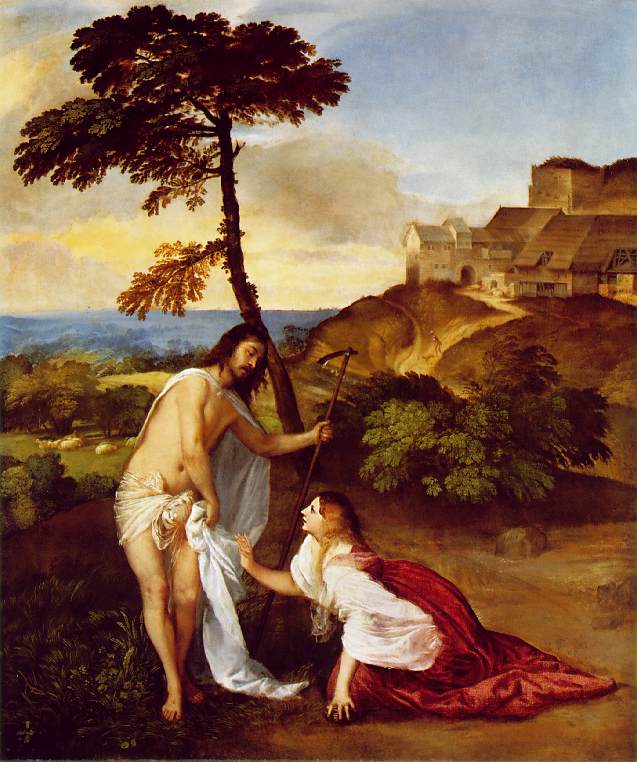
For me it’s been a week of wordy services (apart from a moving silent Eucharist on Wednesday). What’s more, most of the words used do not help me; indeed they hinder my sense of participating in new life by encouraging me to forget my connectedness with other human beings and the rest of the created world. John’s Gospel has Thomas, who doubted the Resurrection, demanding physical proof. He wanted to touch Jesus, in contrast to Mary who, in the same Gospel, encounters the risen Jesus in the garden and is told, ‘Don’t touch me’. (See Titian's wonderful painting of this moment.) It’s an understatement to say that the Gospels are ambiguous about the post-resurrection appearances of Christ. They have him eating food but passing through closed doors and going unrecognised even by those who loved him intimately. The controversial 1980s Bishop of Durham, David Jenkins, caused a storm by saying, ‘the Resurrection was not a conjuring trick with bones’, and ‘the bones of Jesus lie somewhere in Palestine’.

I wake up this morning feeling tired after a restless night and stuff starts flooding my head: ‘I shouldn’t be feeling like this’; ‘I’ll need a sleep this afternoon’; ‘my eyes are feeling prickly’. Then, mixed up with all this is theological stuff about what the church’s liturgy says that I don’t agree with. In other words I find myself forgetting that I am somebody: literally some-body. Eventually, I am reminded – yes, re-minded - and move from ‘doing’ mode to being mode by simply noticing, without judgement, the physical sensations that constitute the vibrant body that is me. Suddenly I feel alive again; connected with myself and the world in which I live and move and have my being and thus able to relate to my fellow human beings.
“Every breath we take includes a billion molecules of oxygen that have come from plants. And every molecule we breathe in has been at one time in the lungs of every one of the 50 billion humans who have ever lived. The simple act of breathing connects us in this intimate way with the plants and every person of the past of every race, religion and culture.”
So at least one molecule of oxygen that I breathe in was in the lungs of Jesus of Nazareth. Now that is resurrection of the body!!

Monday, 29 March 2010

Now. And then.

It’s Holy Week: the crux (and that’s precisely the word!) of the church’s liturgical year. The Gospels devote a surprising amount of space to the last week of the life of Jesus of Nazareth; six out of Mark’s sixteen chapters, for example. Like much else in the Bible and subsequent Christian teaching, however, we struggle to understand what it might all mean. We think we know and quite often reject the understanding we have inherited.

The genius of the Christian church was to preserve a memory of Jesus of Nazareth and his teaching. The problem for us in the 21st century is that it did so in terms which are now alien to us. However, the church also managed to preserve aspects of Jesus which contradict the orthodox view of him and his message. So Christians rapidly made him into a saviour and it’s doubtful whether he would have approved of that. By the way, didn’t they equally rapidly make the Buddha into a saviour?

‘Kenosis’ is a New Testament Greek word meaning something like ‘self-emptying’; letting go of my ego. Most of what Jesus taught only makes sense if we remember that. Good Friday also only makes sense in that light. Jesus taught and lived a life of ‘kenosis’. He did not ‘die for my sins’. He died because, at that point, in those circumstances, any other course of action would have been unthinkably inconsistent with his teaching and his way of living. His death was not unique. Lots of people have surrendered their lives willingly for the same reason.

What Jesus did was to point to and demonstrate profound truths about what it is to be truly human. His was the power of living each moment as it comes, as it is, without burdens from the past or worries about the future. The thrust of his teaching is: the Kingdom is always present and available to us – now, and if you look anywhere (or perhaps I should say ‘anywhen’) else you’ll miss it. This is what he called ‘the narrow gate’ which few find.

The effect of the church’s annual round of festivals is to obscure this fundamental truth. For example, if I attend a Holy Week service recalling that last week of his life, I do it now. On Maundy Thursday I do it now. On Good Friday I may be recalling the then of that first Good Friday but I am doing so now. I am writing these words now and you (whoever or wherever you may be) are reading them now (whenever that may be). There is only always the eternal Now in which I can experience the power of (to use the Christian word) the resurrection. A church service too often says, ‘Look back to where you’ve come from; and look forward to where you’re heading. Jesus says, ‘Leave the dead to bury their dead’. Don’t be concerned about the future – ‘consider the lilies of the field’.

The Gospel, the good news, is: there isn’t anything else to know or do. The price (if that is the right word) is to let go of ego which is almost exclusively concerned with past and future. It’s not that we don’t have to remember and plan; only that to be fully human we must get the present right and then past and future begin to fall into place.

Saturday, 13 March 2010

Stress!!

Today’s Times, Weekend section, proclaims that in “Anxious Britain” 70% of us are stressed, 55% have been depressed, 20% have had therapy and 31 million antidepressant drugs are dispensed every year. Inevitably these days, meditation is one of the recommended strategies for dealing with this onslaught. Earlier this week I read somewhere of the ‘commodification’ of meditation and it is apparent that self help gurus can make a handsome living, especially in the USA.

So, from the religious viewpoint, what are we to make of the current popularity of meditative techniques? Surely, we must welcome anything which might help people to develop a new way of being-in-the-world? They certainly don’t find much help in contemporary Christianity; perhaps the churches are rediscovering too late and too slowly, their ancient tradition of meditation and contemplative prayer.

There are pitfalls (for everone including religious people) when one uses meditation merely as a ‘technique’ to cope with stress or to enhance one’s life prospects. Jesus warned of these dangers when he is reported to have said,
“Not every one who says to me, ‘Lord, Lord’ shall enter the kingdom of heaven, but he who does the will of my Father.”
It’s not that Christians should be tempted to claim exclusive rights to meditation. We should welcome any signs that people are discovering what it might mean to be truly present in the world from the depths of their being. But as Jesus also said.
”Beware of false prophets .... you will know them by their fruits.”


So is there an added ingredient to Christian meditation? Well, compared with self help meditation there might be. It is already present in the Buddhist mindfulness approach since Buddhism regards the self as an illusion anyway. For Jesus the self was something to be 'denied' and the modern recovery of the Christian contemplative tradtition comes close to Buddhism in asserting that the self to which we are so attached is a 'paste up' job which is also pretty illusory. Illusory it may be but the ego - my picture of myself - will defend the illusion even if it is pasted up out of a random selection of memories, attitudes and roles which we play. Maybe most of our stress comes from our dogged attempts to preserve the ego we have so painstakingly constructed since childhood. As someone has said, 'Our anxiety comes mainly from our search for tranquility'.

The Christian added ingredient is 'kenosis' - the New Testament Greek for self-emptying - letting go of any idea we have about who we are until we find the truth deep within us. With no ego to defend stress is taken care of.

Saturday, 27 February 2010

Will the real Jesus please stand up.

'Will the real Jesus please stand up' is the title of the first session of a Lent course on contemplative prayer that I am running for St.John's Waterloo


The course is a 'journey home' - to a place that is familiar and safe -
“We remember wholeness so readily because we don’t have far to look for it. It is always within us, usually as a vague feeling or memory left over from when we were children. But it is a deeply familiar memory, one you recognize immediately as soon as you feel it again, like coming home after being away a long time. When you are immersed in doing without being centred, it feels like being away from home. And when you reconnect with being, even for a few moments, you know it immediately. You feel like you are at home no matter where you are and what problems you face.” (Jon Kabat-Zinn, Full Catastrophe Living, page 95.)

Or as St. Augustine said, "You have made us and our hearts are restless 'till they find their rest in you."

Home has two doors: one, our physical body (the temple of the Spirit) and two, the present moment (the 'narrow gate')

We looked at the announcement of Jesus's message at the beginning of Mark's Gospel: "The time is fulfilled, and the kingdom of God is at hand; repent and believe in the Gospel." The good news Jesus was announcing is that the contemplative life is for everyone: the Kingdom is now and it is within and it is about 'repentance' - but how wrong can you be about repentance!

We entered another brief period of silence after which I asked people to look again at the verse but this time to focus on the negative spaces, within and between the letters. This I suggested is repentance; it's a change of focus, of one's field of view, and way of looking at things. A mind shift has taken place which is what Jesus wanted his hearers to understand.

In feedback on this one person who is a graphic designer talked about using gobbledogook when designing a layout so that the designer's brain doesn't focus on the sense of the words but on the pattern of the layout. "The devil is in the detail" she said, and we had great fun with that; the 'devil' undoubtedly confuses the big picture with details! The trick in the contemplative life is not to lose sight of the big picture. Especially don't let the details of my life, who I think I am, blind me to the truth about me which is that I am rooted and grounded in love - and so is everyone else no matter what the external details of their life and behaviour may be.

But when we enter the silence of contemplation what about distractions? Are they the same as 'temptations'? We thought they were. Distractions are always temptations to leave the present moment and the object of meditation is to let the past go (leave the dead to bury their dead) and not anticipate the future (take no thought for tomorrow). It's not that the mind can ever be free of distracting thoughts. The big question is what you do with them. Confession, I suggest, is the basic stance of prayer, i.e. acceptance of whatever is going on in us without judging it as 'good' or 'bad'. Nothing can be effectively dealt with until it is fully acknowledged. Two of the most important words Jesus said were, 'judge not'.

Next week Jill Benet of Contemplative Outreach will be leading us into the art of Centering Prayer.