Friday, 25 June 2010

Planets, plants and people.

I don’t know who Edmund Spencer had in mind when he wrote the following sonnet in 1595 but even if it was simply a woman, like all good poetry it means more than it says.

Lacking my love I go from place to place,
Like a young fawn that late hath lost the hind:
And seek each where, where last I saw her face,
Whose image yet I carry fresh in mind.
I seek the fields with her late footing signed,
I seek her bower with her late presence decked,
Yet nor in field nor bower I her can find:
Yet field and bower are full of her aspect.
But when mine eyes I thereunto direct,
They idly back return to me again,
And when I hope to see their true object,
I find myself but fed with fancies vain.
Cease then my mine eyes, to seek herself to see,
And let my thoughts behold herself in me.


We look in lots of places (even in monasteries and churches) for the truth about ourselves and then finally, if we are lucky, we find it in the depths of ourselves; and this leads, not to introspection, but to a sense of our being one with all that is: ‘planets, plants and people’ as someone said to me only this morning.

Gerard Manley Hopkins wrote, “The world is charged with the grandeur of God”. He coined the words ‘inscape’ and ‘instress’; ‘inscape’ meaning, “....that individually-distinctive form (made up of various sense-data) which constitutes the rich and revealing ‘oneness’ of the natural object....”; ‘instress’ meaning, “.... that energy of being by which all things are upheld...that natural (but ultimately supernatural) stress which determines an inscape and keeps it in being .... but not only the unifying force within the object; it connotes also that impulse from the inscape which acts on the senses....”

It’s relatively easy to appreciate the beauty of the so-called ‘natural’ world without allowing that human beings are part of it. (Planets, plants and people.) Wordsworth, another poet deeply moved by nature, allowed the inscape and instress to lead him into the depths of himself:
“Nor less, I trust,
To them I may have owed another gift,
Of aspect more sublime; that blessed mood
In which the burthen of the mystery,
In which the heavy and the weary weight
Of all this unintelligible world,
Is lightened: - that serene and blessed mood,
In which the affections gently lead us on, -
Until, the breath of this corporeal frame
And even the motion of our human blood
Almost suspended, we are laid asleep
In body, and become a living soul:
While with an eye made quiet by the power
Of harmony, and the deep power of joy,
We see into the life of things.”

(From ‘ Lines composed a few miles above Tintern Abbey.’)

To ‘see into the life of things’ (including people) is to be aware of their instress (their ‘thisness’) and their inscape (that which holds them, as well as me, in being) and this awareness constitutes the beginning of compassion.

Friday, 18 June 2010

Promises, promises

Like the debris which now floats in space the internet is littered with abandoned blogs. I am aware of not posting anything for weeks now. If anyone out there actually likes to read what I write, I apologise for disappointing you. But what to do? My wife, Yvonne, suggests promising just one posting a week. I’ll try it!

We’ve just returned from two weeks on the Greek island of Symi. Above the magnificent harbour is the church of Evangelismos with its tessellated pavement and tall cypress trees, each surrounded by a little wall exactly the right height to sit on. There, in the shade, with a gentle breeze to cool me, and a view across the water to the tumbled mountains of Turkey, as the yachts of the rich came and went below, I took to settling down for a daily meditation. I use a prayer word (or mantra) to help me focus: ‘Be still’, with ‘be’ on the in-breath and ‘still’ on the out-breath. It’s a phrase which has echoes of Psalm 46: ‘Be still and know that I am God’, and of Jesus’ words in calming the fears of the disciples when caught in a storm on lake Galilee. After a while I noticed that the pigeons on Symi have a simpler coo to those in London. It’s a three note call: a short beginning, a longer middle, and a much shorter third note – coo-cooooo-co. I heard, ‘be s-t-i-l-l now’. There was no need for me to repeat my prayer word. The pigeons were doing it for me!

The word ‘holiday’ comes from ‘holy day’ in the days when Christian festivals provided the only available break from work. Holidays on Symi are a bit like that. Life is simplified; no newspapers or television; and not much in the way of ‘entertainment’. I had taken with me, Martin Laird’s book ‘Into The Silent Land’. I know it well; in fact I had become over-familiar with it. This time, I read it slowly and mindfully, re-discovering its hidden treasures, and understanding, for the first time really, what he means by ‘the liturgy of our wounds’.

Stuff is stored away in our brains from earliest times and it’s the painful bits which seem to float up (or sometimes erupt) into consciousness; it’s the persistent annoying mental tics which never seem to give up, especially when one is trying to ‘be still’. I learnt this time to be compassionate with all that; to let it be, to forgive myself; to understand that this human body with its marvellous mental apparatus, its persistent weakness and failure and, ultimately, its death, is also the vehicle of – what? Some call it God but that word presents so many difficulties. Martin Laird is fond of paradoxical statements like ‘depthless depth’ and ‘the groundless ground that is the core of all being’. He writes,
“The very attention that gazes into this vastness is itself this vastness, luminous depth gazing into luminous depth. You are the vastness into which you gaze.”

Buddhists can describe this sort of thing somewhat less paradoxically but then they don’t have to cope with a tradition of God as an object out there. Still you cannot be much more direct and simple than Martin Laird’s, “God does not know how to be absent”.
See you next week, I hope (promises, promises).

Sunday, 23 May 2010

Speaking personally

Pentecost!
Listening to a ‘homily’ this morning, I am reminded of Harry Williams’s dictum: ‘I am not speaking theologically unless I am speaking personally’. Too many sermons are confined to rehearsing the ‘facts’ presented in a Bible passage, together perhaps with reference to what the church has, over the centuries, made of these ‘facts’ liturgically. Thus the possibility that this episode might speak to me - now is missed. This kind of talk tells us nothing much about the speaker and conveys little of immediate value to the hearer.

Whatever else it was that the author of Luke/Acts was trying to express, it was certainly about conveying an experience; communicating it in a penetrating and exciting way to people of many different cultures and languages. This kind of ‘talk’ is only achieved through presence in the most profound sense of the word: Presence which transcends words.

But also, one doesn’t always need to get excited about it! Joy and excitement or enthusiasm are not inseparable. There is a deep still, silent joy as well as a wild enthusiastic one.

Monday, 12 April 2010

Approach and avoidance.

A passage in ‘The Mindful Way Through Depression’ helps me deal with yesterday’s collapse of the Now Show. As always, of course, it is something I already know but forget when it is needed. In this case a new helpful angle, however, is the distinction between the brain’s avoidance mode and its approach mode. Approach mode is Thomas Keating’s ‘Welcome Prayer’ in Buddhist dress. The heading is ‘Befriending Thoughts and Feelings’.
“In doing this work, we are learning how important it is to bring mindfulness to those times that we become alerted to the presence of unpleasant thoughts and feelings. It is tempting at such times to switch our attention away as soon as we detect that the thoughts and feelings are unpleasant and to return our attention back to the haven of the breath. But it is more skilful to pause long enough to bring to them a spirit of gentle inquiry and curiosity, an investigative awareness. ‘Ah there you are; let me see who you are’. In this way .... we are in much better shape to become familiar with the content of recurring messages. Furthermore, this sense of openness, curiosity, and exploration will activate the approach mode of the brain. In itself, this will directly counteract the avoidance mode and so provide a further steadying influence that can prevent us from getting caught up in and carried away in all our own imaginings.” (Page 176/7)
I love the calm, scientific tone of this, carrying no religious overtones at all. I had walked down the road to Cafe Nero and, having read this there, walked back a totally different person, set free from oppressive and afflictive thoughts. People must have had that experience when they encountered Jesus.

In the evening I hear Philip Pullman at the Queen Elizabeth Hall talking about his new book, The Good Man Jesus and the Scoundrel Christ. He refers at one point to the impracticality of ‘Consider the lilies of the fields .... Take no thought for the morrow....’ He clearly doesn’t know about Keating’s ‘Wisdom’ approach to the message of Jesus. For example in a yoga/meditation session I have a plan, a goal: the sequence of poses – but it is important to take each moment as it comes, each pose and each transition is to be accomplished here and now without anticipation or judgement. Take no thought for the morrow does not preclude plans and goals. It is just that any journey, however long and complicated, begins with one step and continues moment by moment with each step.

Thursday, 8 April 2010

Getting it wrong!

In meditation this morning: a wave of compassion for Paul of Tarsus who occasionally got it so wrong!
“For this we declare to you by the word of the Lord, that we who are alive, who are left until the coming of the Lord, shall not precede those who have fallen asleep. For the Lord himself shall descent from heaven .... then we who are alive, who are left, shall be caught up together with them in the clouds to meet the Lord in the air.”
It is easy to forget what a different world they inhabited; and yet, and yet: “If I speak with the tongues of men and angels, but have not love, I am a noisy gong or a clanging cymbal.”

Monday, 5 April 2010

'Doing God'?

Madeleine Bunting writing in today’s Guardian about the flurry of atheist books on the market, says that “religious faith in the west came to be interpreted as a matter of the head and the intellect, and was bound up with the authority of an institution which expected submission: God was regarded as something to think about rather than do in large chunks of western religious practice which, preoccupied with institutional power, ended up in this current cul de sac.” Looking back it’s obvious that I spent my thirty five years of priestly ministry in the dying years of that mindset. The clues to what might become the future were there for us to see but those of us who stayed within the institutional church (in my case, of England) didn’t really get it in spite of our unease with what we were expected to believe. It was something to do with the steady drip, drip of the liturgy which still emphasises the gap between us and God, in spite of Paul Tillich’s ‘ground of being’ approach, which Bishop John Robinson so controversially spelt out in 1963.

So now, says Bunting, it’s OK to ‘do God’ and I agree that praxis is more important than belief. It’s just that I’m a bit unhappy with that phrase, ‘doing God’. These days I prefer a much more controversial phrase: ‘being God’. In his ‘The Little Book of Atheist Spirituality’ the French philosopher, Andre Comte-Sponville, writes, “Whether they are believers or not, mystics are those who no longer lack God. But is a God who is no longer lacking still God?”

I don’t know the answer to his question. My response is to ask another question: Why is it that when human beings, in our left brain dominated world, learn how to access the right brain (i.e. to meditate) they experience love, compassion and a sense of connectedness with all living things? And what did Jesus mean when, according to John’s Gospel he said, ‘I and the Father are one’ and ‘I am the vine. You are the branches.’?

Sunday, 4 April 2010

The Resurrection of the body.

So we come at last to the end of Holy Week and, according to the Gospel writers, the tomb is empty.

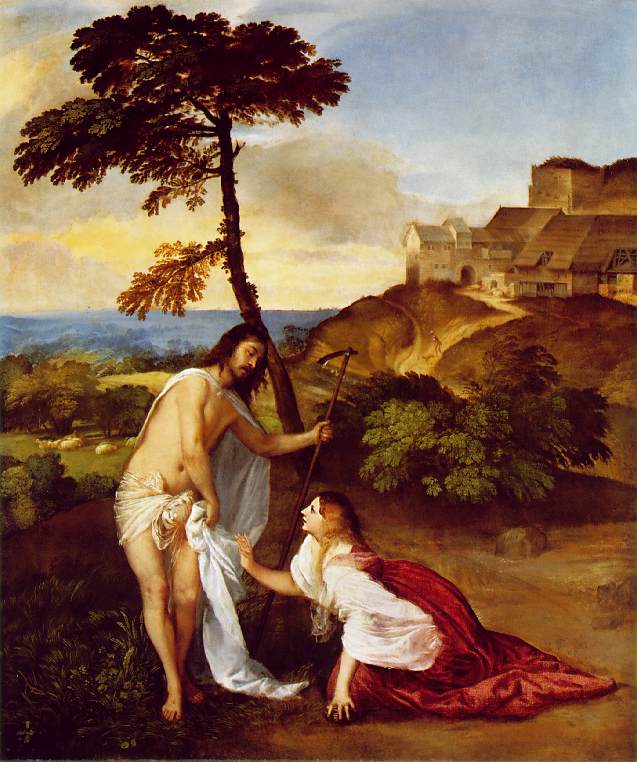
For me it’s been a week of wordy services (apart from a moving silent Eucharist on Wednesday). What’s more, most of the words used do not help me; indeed they hinder my sense of participating in new life by encouraging me to forget my connectedness with other human beings and the rest of the created world. John’s Gospel has Thomas, who doubted the Resurrection, demanding physical proof. He wanted to touch Jesus, in contrast to Mary who, in the same Gospel, encounters the risen Jesus in the garden and is told, ‘Don’t touch me’. (See Titian's wonderful painting of this moment.) It’s an understatement to say that the Gospels are ambiguous about the post-resurrection appearances of Christ. They have him eating food but passing through closed doors and going unrecognised even by those who loved him intimately. The controversial 1980s Bishop of Durham, David Jenkins, caused a storm by saying, ‘the Resurrection was not a conjuring trick with bones’, and ‘the bones of Jesus lie somewhere in Palestine’.

I wake up this morning feeling tired after a restless night and stuff starts flooding my head: ‘I shouldn’t be feeling like this’; ‘I’ll need a sleep this afternoon’; ‘my eyes are feeling prickly’. Then, mixed up with all this is theological stuff about what the church’s liturgy says that I don’t agree with. In other words I find myself forgetting that I am somebody: literally some-body. Eventually, I am reminded – yes, re-minded - and move from ‘doing’ mode to being mode by simply noticing, without judgement, the physical sensations that constitute the vibrant body that is me. Suddenly I feel alive again; connected with myself and the world in which I live and move and have my being and thus able to relate to my fellow human beings.
“Every breath we take includes a billion molecules of oxygen that have come from plants. And every molecule we breathe in has been at one time in the lungs of every one of the 50 billion humans who have ever lived. The simple act of breathing connects us in this intimate way with the plants and every person of the past of every race, religion and culture.”
So at least one molecule of oxygen that I breathe in was in the lungs of Jesus of Nazareth. Now that is resurrection of the body!!